



FROM FRAGMENTED TO FOUNDATIONAL: BUILDING A PROVIDER DATA BACKBONE
When a large, Arizona-based government healthcare insurance administrator won a major contract, the challenge wasn’t incremental improvement; it was standing up an entirely new provider data foundation quickly.
Provider data existed across disparate sources, formats, and systems with numerous inconsistencies. At the same time, strict regulatory requirements and aggressive timelines meant the administrator needed to operationalize quickly to meet network requirements tied directly to reimbursement.
The organization originally relied on two core systems: Anchor Point for provider data management and Visual Cactus for credentialing. These systems supported both legacy and active contracts but had limitations.
To address this, they implemented Salesforce to build a new custom provider data management system and adopted Verifiable and Reliable for credentialing. To ensure consistent and standardized data across systems, they also implemented Profisee as their master data management (MDM) solution.
Azulity partnered with the administrator to design and implement a Master Data Management (MDM) solution that would serve as the backbone for provider and location data.
The Approach
Azulity led the end-to-end stand-up of a cloud-based MDM platform, including:
- Aggregating legacy and network data sources into a single system
- Ensuring compliance with regulatory guidelines, including PGBA, Care Radius, DEERS, Kyruus, Reporting/Analytics, Salesforce, Beneficiary and Provider portals
- Creating “golden records” for providers with a unique identifier for downstream consumers – Availity, Reliable, and Kyruus – to match on
- Enriching incomplete data using third-party sources like LexisNexis, Blue Health Insight, and NPPES
- Standardizing complex provider relationships across organizations, facilities, and locations
- Profiling and validating incoming data from multiple network partners
Across all of this, data quality was a major challenge. Azulity implemented standardization, cleansing, and custom solutions to help address it and built error-handling processes to automatically identify and surface data issues that enabled source owners to correct them at the source.
Beyond technology, Azulity acted as a critical bridge between the client and its network subcontractors — translating data requirements, resolving inconsistencies, and helping partners deliver data in usable formats.
The Difference
This wasn’t a typical implementation. Azulity operated as both technical partner and operational advisor, guiding data strategy, ensuring regulatory alignment, and supporting stakeholder coordination across a highly complex ecosystem.
Azulity’s deep domain expertise in provider data, credentialing, and healthcare compliance proved essential in enabling the team to anticipate risks, enforce standards, and maintain momentum under pressure.
The Impact
Within an accelerated timeline, the healthcare administrator successfully established a trusted provider data foundation and met critical onboarding milestones required to support reimbursement and network operations.
Through this work, the volumes are staggering:
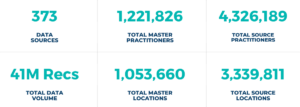
The work set the client up for future success by delivering:
- A unified, standardized provider data backbone
- Improved data accuracy and consistency across sources
- Scalable infrastructure to support ongoing data updates and network expansion
- A sustainable operating model supported by internal teams trained by Azulity
What began as a high-risk, high-pressure initiative became a foundational capability enabling the client to move forward with confidence.
Key Lessons Learned
Through this work the team identified several learnings to carry forward:
- Coordinate infrastructure readiness. Align deliverables with infrastructure availability to support smooth implementation and avoid delays.
- Include architecture early in data discussions. Involving solution architects during data feed negotiations helps ensure scalable, reusable designs, alignment with business needs, and clarity for source owners on data expectations.
- Clarify roles and responsibilities. Establishing a RACI matrix ensures everyone understands their role and promotes accountability across teams.
- Optimize MDM design for efficiency. In Profisee implementations, carefully evaluating matching and survivorship, especially for associative entities, can help manage data volume and cost. Exploring alternative approaches, such as custom outbound objects for downstream use, can improve efficiency and scalability.
About Azulity
Azulity helps healthcare organizations turn fragmented data into a standardized, interoperable foundation they can trust. We specialize in consulting and implementing data management solutions built for the real-world complexity of healthcare, where accuracy, consistency, and connectivity matter. With deep industry expertise, we partner with teams to standardize provider and patient data, align it to industry standards, and ensure it flows seamlessly across systems. The result is cleaner data, fewer downstream issues, and stronger interoperability. Our tailored approach combines the right technology with proven data governance to support smarter decisions, stronger operations, and better care delivery.